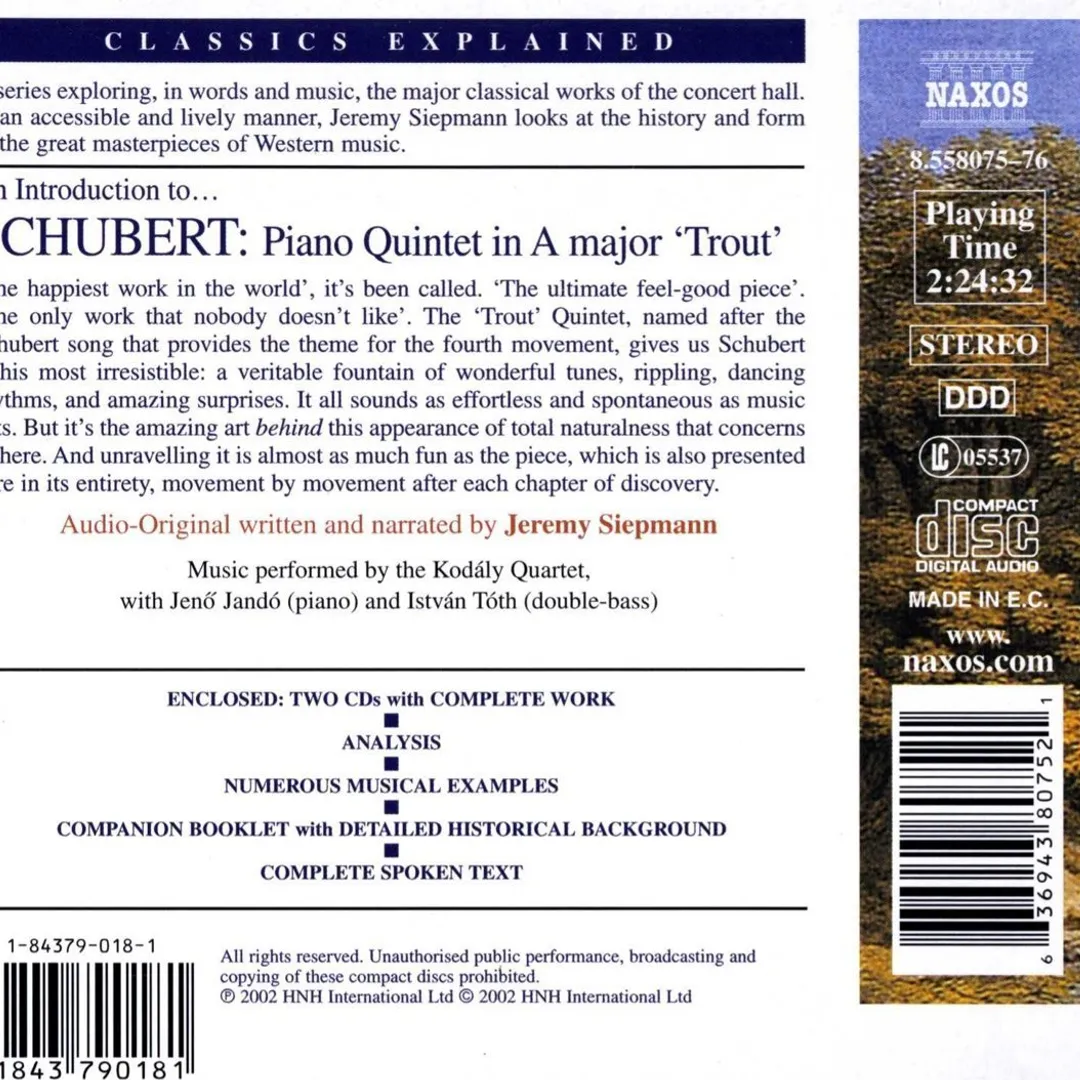
Classics Explained: Schubert Piano Quintet "Trout" (Written and Narrated by Jeremy Siepmann)
Compilation by Franz Schubert
About
Disc 1
- 1.Introduction, origins1:39
- 2.Imagery, analogy and the shape of the things to come; the opening flourish1:50
- 3.The unusual presence of the double-bass0:54
- 4.A palette of tone colours and the emergence of a theme0:47
- 5.Trouble getting off the ground, but the key is not in doubt.0:49
- 6.Jumping the queue: Schubert takes a lesson from Mozart.1:33
- 7.Mozart demonstrates a traditional transition.0:33
- 8.Destination clarified0:07
- 9.Mozart confirms our arrival.0:08
- 10.A Schubertian shocker from a later work0:52
- 11.Rejoining the 'Trout', with a reminder0:27
- 12.The piano joins the strings with yet a third variant of the theme.0:31
- 13.A rhythmic motto: the 'triplet motif'1:26
- 14.We get it here.0:17
- 15.We get it there.0:17
- 16.We find it everywhere, even in the double-bass.0:27
- 17.The strings' answer to the piano's opening flourish0:36
- 18.The two-part structure of the 'answering motif'...0:24
- 19....but scarcely ever the same way twice0:34
- 20.The piano and strings now share the material for the first time.0:42
- 21.Conversation as the first principle of chamber music0:43
- 22.Opening (introductory) section heard complete1:01
- 23.The violin and double-bass in partnership1:16
- 24.The violin and piano swap roles.0:59
- 25.Transition to second main theme; triplets now everywhere1:12
- 26.On the threshold of the new theme0:30
- 27.Second main theme (a 'love duet'), shared by cello and viola1:24
- 28.The abandonment of octaves in the piano changes the tone colour.1:07
- 29.A surprising change of tone and a premonition0:39
- 30.A return to lyricism, but the cello jumps the gun0:37
- 31.A buoyant, skipping new theme is given to the solo piano.0:36
- 32.Re-entry of the strings as the violin takes up the new theme0:25
- 33.A transitional theme, and another Schubertian key-jump1:33
- 34.We sense the imminent arrival of the closing theme.1:31
- 35.A sudden, hushed key-change introduces part two of the closing theme.0:40
- 36.The exposition comes to an end.0:32
- 37.Cue to complete exposition0:06
- 38.Music: exposition complete4:09
- 39.Introduction to the development; the genetic code of 'key'7:20
- 40.The contrasting aural properties of piano and violin1:03
- 41.The ponderous double-bass is featured in the first main theme0:49
- 42.The strings are liberated from servitude, but are a long way from home.0:42
- 43.A joyful conversation and a change of pace in the piano1:06
- 44.The piano takes the melodic lead again.0:31
- 45.A conversation between violin and piano leads to the exposition...1:20
- 46....but Schubert gets it 'wrong'.1:35
- 47.Piano Quintet in A major "Trout", D. 667: I. Allegro vivace (Kodály Quartet feat. piano: Jenő Jandó)9:09
- 48.Introduction to second movement1:53
- 49.The violin now takes theme one.0:29
- 50.The piano regains the theme.0:42
- 51.The violin and piano round off first section with the new 'closing' theme.0:35
- 52.A major change of tone: a passing cloud and a dark new key1:19
- 53.The piano abandons its octaves, but not its triplets, in the new 'Hungarian' theme.1:28
- 54.The sun returns with a new theme, in two contrasting parts.1:21
- 55.An evaporating dialogue between violin and piano0:58
- 56.A major mood change as twilight falls1:12
- 57.Cue to whole movement0:33
- 58.Piano Quintet in A major "Trout", D. 667: II. Andante (Kodály Quartet feat. piano: Jenő Jandó)7:30
Disc 2
- 1.Introduction to the Scherzo - And a Clear Four-Bar Phrase...1:37
- 2...."Answered" by Two Two-Bar Phrases0:21
- 3.A Disconcerting "Echo"1:02
- 4.Expectation, Frustration and Surprise0:27
- 5.The Phrase Length Exands From Nine to Fourteen Bars0:36
- 6.The Beginning of the Second Half...1:07
- 7.... or Should It Go From G minor to D major?0:08
- 8.Doubts Are Sown as the Tonality Becomes Elusive.0:48
- 9.A Varied Reprise of Part One, and the End of the Scherzo Proper0:33
- 10.A Conversational Start to the Trio Section0:40
- 11.Another Schubertian Phrase Extension0:25
- 12.Two Overlapping Phrases Add Up to a Single Theme.0:22
- 13.The Piano Adds a Third Phrase to the Overlap.0:32
- 14.The Overlaps Continue as the Key Drifts Downwads0:36
- 15.Another Schubertian Key-Jump, Now to B flat0:45
- 16.A Dramatic Transformation of Mood0:52
- 17.Awakening From a Dream: The Main Theme's Return0:51
- 18.Cue to Complete Scherzo0:11
- 19.Piano Quintet in A major "Trout", D. 667: III. Scherzo: Presto (Kodály Quartet feat. piano: Jenő Jandó)3:52
- 20.Enter the Trout, at Last; A Meeting With the Original0:30
- 21.Music: "Die Forelle"1:59
- 22.Back to the Quintet: The Strings, Headed by the Violin, Introduce the Theme.1:24
- 23.The First Variation1:41
- 24.The Second Variation1:14
- 25.The Third Variation1:20
- 26.The Fourth Variation, Part One1:33
- 27.The Fourth Variation, Part Two0:57
- 28.The Fifth Variation2:45
- 29.The Final Variation, Part One: Violin and Piano Alone Introduce the Theme0:31
- 30.The Final Variation, Part Two: The Cello Takes the Tune.0:25
- 31.The Final Variation, Part Three: Piano and Violin Return as a Duo...0:25
- 32.The Final Variation, Part Four: ...as Do the Viola and Cello.0:17
- 33.The Final Variation, Part Five: The Entire Ensemble Is Reunited.0:39
- 34.Piano Quintet in A major "Trout", D. 667: IV. Theme: Andantino (Kodály Quartet feat. piano: Jenő Jandó)7:09
- 35.Introduction to the Finale: Schubert as Wizard of Repetition2:17
- 36.Easily Overlooked: The Accompaniment From Cello and Double-Bass0:36
- 37.Contrasts of Timbre and Register0:59
- 38.A Repetition, and Yet Not a Repetition0:07
- 39.A Journey Begun; The Phenomenon of Musical Gravity0:22
- 40.The Journey Completed0:16
- 41.The Source of Musical Gravity0:22
- 42.Music: Saint-Saens - The Carnival of the Animals "The Pianists"0:28
- 43.A Scale of Shifting Tensions0:49
- 44.Music: Beethoven, Symphony No. 1 (Finale)0:37
- 45.Back to Schubert0:39
- 46.The Piano Embellishes a Scalewise Descent.0:18
- 47.A Retrospective Moment0:33
- 48.Repetition More Apparent Then Real1:02
- 49.A Taste of Phrase Rhythm1:26
- 50.Shifting Patterns of Accentuation0:27
- 51.The Section Reviewed0:15
- 52.An Increasingly Sophisticated Texture as Parts Interact0:46
- 53.More Phrase Rhythm0:29
- 54.A Repetition From the Strings...0:11
- 55.... and an Answer From the Piano0:13
- 56.In Transition to the Secondary Key0:51
- 57.The Origin of the Second Theme0:19
- 58.The Second Main Theme0:38
- 59.The Closing Section Begins, With a Question Answered.0:42
- 60.The Question Repeated, a Slightly Different Answer0:28
- 61.First Theme of Closing Section Reviewed0:59
- 62.Remembrance of Things Past0:28
- 63.The Piano and Strings Argue Over the Harmony.1:13
- 64.Emergence of the Final Theme0:24
- 65.An Unexpected Thunderstorm0:51
- 66.The Sound of Silence1:29
- 67.Cue to Complete Finale1:00
- 68.Piano Quintet in A major "Trout", D. 667: V. Finale: Allegro giusto (Kodály Quartet feat. piano: Jenő Jandó)6:47