RMX16
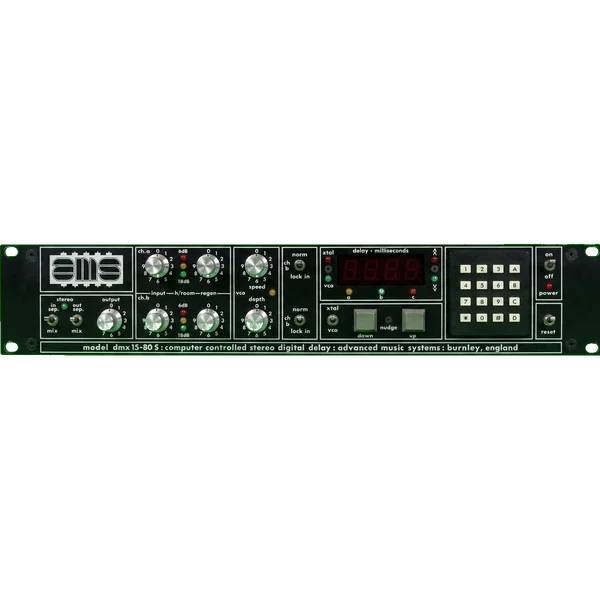
Effects by AMS
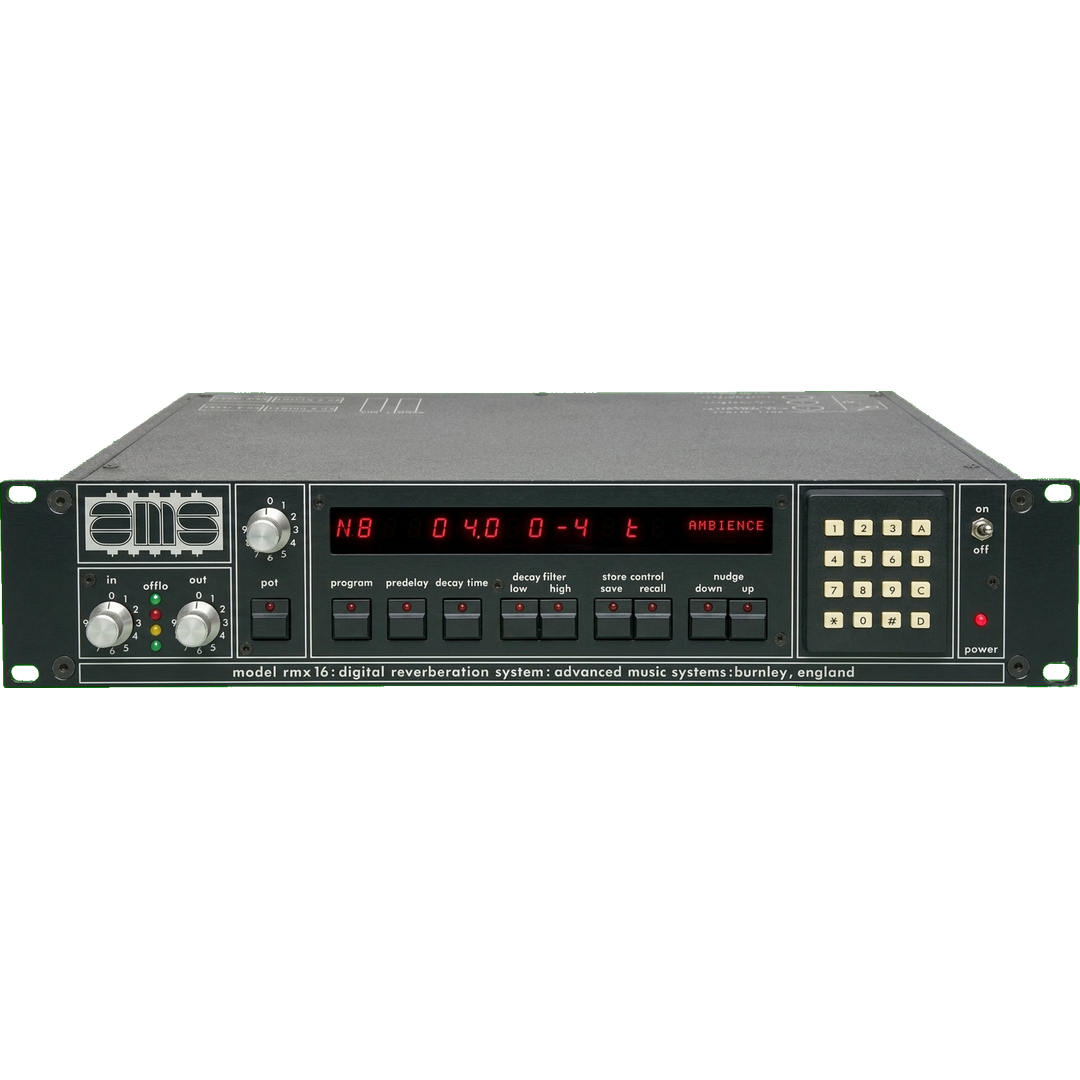
The AMS RMX16, introduced by Advanced Music Systems in 1982, was the world's first integrated microprocessor-controlled digital reverberation system. Its NonLin2 gated reverb programme defined the cavernous drum sound of 1980s pop and rock records, and the unit remains a benchmark for studio reverb to this day.
Specifications
| Type | Digital reverb |
| Controls | Calculator-style numeric keypad, LED-illuminated parameter pushbuttons (program, pre-delay, decay time, Lo-decay and Hi-decay filtering), up/down nudge buttons, alphanumeric display, assignable parameter rotary, input and output level pots |
| Bypass | Output muted during program change (no dedicated bypass switch) |
| Delay Time | 0 to 1.6 s in 1 ms increments (810 ms in dedicated Delay program) |
| Chip | Custom microprocessor-controlled parallel processor at 22 MHz, 16-bit data path; 12-bit A/D with 2-bit gain ranging giving 16-bit linear word; 28-bit internal arithmetic |
| Series | RMX series (successor to DMX15R add-on) |
| Format | 19-inch 2U rack |
| Dimensions | 480 x 89 x 322 mm |
| Weight | 12 kg |
| Power Supply | 110 / 220 / 240 V AC, 50/60 Hz (externally adjustable, IEC mains inlet) |
| Power Consumption | 70 VA |
| Connections | Input: 1x XLR female (electronically balanced, 10 kΩ, -10 dBV); Outputs: 2x XLR male stereo (electronically balanced, 150 Ω, +20 dBV max) |
| Notes | Bandwidth 20 Hz to 18 kHz (-3/+0 dB); dynamic range 90 dB; THD <0.03% at 1 kHz; S/N ~86 dB. Nine factory EPROM programmes: Ambience, Room A1, Hall C1, Plate A1, Hall B3, Chorus, Echo, NonLin2 and Reverse1, plus nine user stores (expandable to 99 via optional remote terminal with bar-code wand). 14 vertical plug-in circuit cards on a motherboard chassis; fan-cooled. Designed by Mark Crabtree at Advanced Music Systems, Billington Road, Burnley, Lancashire. |