The story starts with a band that no longer wanted to be in a studio.
OK Computer did not begin as a plan to make a futuristic record. It began with exhaustion. The long, pressured sessions for The Bends had left Radiohead suspicious of conventional studios, while Nigel Godrich had reached much the same conclusion from the other side of the glass. Both wanted a process that felt less like clocking into a workplace.
The first proof arrived before the album sessions. In September 1995, Radiohead and Godrich recorded “Lucky” for War Child’s Help album under a one-day deadline. They came from a show, set up at Marcus Studios, captured the performance, chose the second of two lead vocals, added guitars and moved directly into the mix.
The speed mattered. There was no time to polish the life out of the take, and the result was complete enough to become track eleven on OK Computer. A method had appeared almost by accident: prepare carefully, record decisively, and leave before doubt takes over.
Godrich’s contemporary accountInstead of booking another studio, they built one that could leave.
Parlophone funded a mobile system assembled around a large desk, two equipment racks and an Otari MTR-90II two-inch tape machine. The band called it Canned Applause. Its real innovation was not a piece of equipment but a change in geography: the control room could go wherever the songs were still alive.
The first stop was a refrigerated unit on an Oxfordshire fruit farm—the kind of empty metal box nobody would mistake for a prestigious recording room. Godrich remembered that about four album tracks were recorded there while the material was still developing. Some survived; others were replaced when a better performance arrived.
Later in 1996 the rig moved to St Catherine’s Court near Bath. The library became the control room, but the house was not converted into a fantasy studio. No invented floor plan is needed to explain what mattered: the rooms remained visually and acoustically themselves, the band worked without an assistant or technician, and the recording setup stayed close enough to the musicians to follow them.
The mobile rig and both locationsInside Canned Applause · verified signal
A studio designed to disappear.
The rig kept recording simple enough that the musicians, not the control room, remained the centre. Digital editing was available, but speed, shared performance and physical commitment set the rules.
Stage 01 · Capture
Microphones in a shared room
The band plays within sight of one another, often keeping guide vocals and early performances.
Godrich described simple guitar miking, U47 and RØDE valve vocal microphones, and individual foldback mixes.
Five musicians, in sight of one another, became the main technology.
Godrich’s description of the sessions is strikingly ordinary. Everybody stood in one large room as they might onstage. Each musician had a foldback mix. They could see one another, react to the bare arrangement and keep moving. Most of the album was recorded live.
Guide vocals often became final vocals. “Paranoid Android” and several other songs held onto early or single-take performances because separating the singer from the band later would have meant reconstructing an atmosphere that had already happened. Clicks could establish a tempo, then disappear before they began to dictate expression.
The engineering followed the same logic. Guitars were miked simply. Vocals passed through valve microphones, an 1176 and, when useful, a Pultec. Tape could be driven hard, moved and cut. Fidelity was never allowed to outrank the take.
This is the central reversal of the album’s mythology. The title, the artwork and the Macintosh voice point toward a machine-age future, but the record’s foundation was social and physical: a band performing together into analogue tape.
Live recording, microphones and tapeThe exceptions are where the recording method becomes composition.
“Mostly live” does not mean doctrinaire. Radiohead and Godrich broke their own method whenever a song demanded it. Five tracks show the boundary particularly clearly—not a computer replacing a band, but a specific intervention solving a specific musical problem.
Airbag
Drum performances cut into rough loops
Godrich identified “Airbag” as the album’s sequencing exception: multiple loops made from Phil Selway’s playing were assembled for their deliberately rough, unstable feel.
The audited interview establishes the construction method, but does not assign the finished master to a particular room.
Paranoid Android
Separate performances joined on 24-track tape
Its heavy sections were recorded months apart. Godrich physically assembled the chosen performances so the complete song could run from beginning to end on one reel of 24-track tape.
The source documents the splice and the time between sections, not a room-by-room session log.
Karma Police
Live song with a rebuilt sample-and-loop ending
After the complete song had been recorded, Yorke and Godrich rebuilt its second half from samples and loops, creating a separate bed under the retained vocal.
The source identifies the two-person reconstruction but does not publish a complete sample inventory.
Fitter Happier
Computer speech placed inside an audio collage
Yorke gave the lead role to “Fred,” the speech voice of a Macintosh LC II. Its flat delivery and mispronunciations were retained as the expressive centre of the piece.
The computer supplied the voice; that does not mean the surrounding album was primarily computer-recorded.
No Surprises
Live take altered through tape speed
Yorke said the band returned to an earlier performance and slowed it down before the final vocal, using varispeed to make the apparently simple recording feel subtly wrong.
Secondary retellings disagree about speed direction. This register follows Yorke’s first-person account and does not infer an exact varispeed ratio.
The mixes stayed quick. The sequence supplied the long argument.
The mobile studio had been built to keep Radiohead out of conventional rooms, but mixing returned the project to London. Godrich chose the Neve rooms at Mayfair and AIR and tried to finish a mix in roughly half a day. Longer than that, he felt, and detail began to replace objectivity.
Mixing completed individual recordings; sequencing made them an album. The running order repeatedly alternates movement with interruption: “Airbag” collides with “Paranoid Android,” “Fitter Happier” breaks the band’s physical presence, and “No Surprises” offers deceptive calm before “Lucky.”
Then “The Tourist” closes by slowing the field of vision. Yorke later said the song sounded as though it were about technology, but came from the bodily experience of everything moving too fast. That distinction makes it the right ending: the album’s machines finally resolve into a human request for time.
Godrich on mixing/Yorke on “The Tourist”- 01Airbag4:44
- 02Paranoid Android6:23
- 03Subterranean Homesick Alien4:27
- 04Exit Music (for a Film)4:24
- 05Let Down4:59
- 06Karma Police4:21
- 07Fitter Happier1:57
- 08Electioneering3:50
- 09Climbing Up the Walls4:45
- 10No Surprises3:48
- 11Lucky4:19
- 12The Tourist5:24
Once the album left the house, its documents kept accumulating.
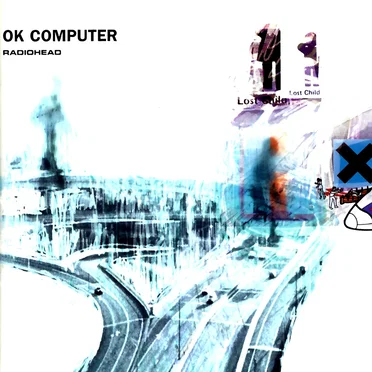
The sleeve had developed alongside the music. Thom Yorke and Stanley Donwood gathered found images, scanned material, computer marks and partial erasures until information itself appeared damaged. The visual process and the recording process shared a grammar: collect, layer, interrupt, keep the traces.
The label initially heard a difficult follow-up without the obvious singles it expected. Critics and listeners heard the scale of the achievement quickly. Success moved the record from a private solution to a public object—and began the long, uncomfortable promotional cycle documented in Meeting People Is Easy.
National Recording Registry
The Library of Congress adds OK Computer to the National Recording Registry and publishes a scholarly account of its historical and formal significance.
OKNOTOK
The anniversary edition remasters the original sequence and adds B-sides and three completed outtakes—a controlled opening of the archive, not a replacement album.
Radiohead Public Library
Official videos, artwork, websites and ephemera become a browsable collection maintained by the band.
Epilogue
OK Computer sounds like a warning from the digital future because its makers knew when not to surrender to the screen.
Its most radical technology was the working arrangement around it: a studio that could travel, a band that could still see one another, tape that could be physically committed, and digital tools used only when a song made the case.
Open the album, tracklist and official playback